Table of Contents
An AV fistula is an important vascular access for people receiving hemodialysis. Recognizing the signs of a failing AV fistula early can help patients seek timely evaluation before access problems interfere with dialysis. Changes such as a weaker or absent thrill, altered bruit, swelling, pain, redness, drainage, bleeding, or reduced dialysis blood flow should be reported to the dialysis team promptly. In Delhi, patients experiencing these changes may need assessment by a vascular specialist to determine the cause and whether the fistula can be preserved.
Medically Reviewed By: Dr. Achintiya Sharma
Last Reviewed: August 2026
What Are the Signs of a Failing AV Fistula?
Common failing AV fistula symptoms include a sudden change or loss of the normal thrill, an altered bruit, reduced blood flow during dialysis, repeated problems with needle placement, swelling, pain, redness, warmth, drainage, or unusual bleeding. These symptoms do not always mean that the fistula has completely failed, but they can indicate a complication requiring professional evaluation.
An AV fistula is created by connecting an artery to a vein, usually in the arm, to provide reliable vascular access for hemodialysis. Because the access is essential for treatment, patients should become familiar with how their fistula normally looks and feels and report significant changes to their healthcare team.
Quick Answers
| Question | Quick Answer |
| Main warning sign | A sudden change or loss of the normal fistula thrill |
| Other symptoms | Changed bruit, swelling, pain, redness, drainage, bleeding, or poor dialysis blood flow |
| Common causes | Stenosis, thrombosis, infection, or inadequate maturation |
| What should you do? | Contact your dialysis team promptly if the access changes |
| How is it diagnosed? | Physical assessment and, when needed, vascular imaging or other investigations |
| Can it be treated? | Some fistula problems can be repaired or the access can potentially be salvaged |
| When is it urgent? | Sudden fistula dysfunction can occur when a clot, narrowing, or another vascular problem interferes with normal blood flow. |
Why Are the Signs of a Failing AV Fistula Important?
The signs of a failing AV fistula can indicate that blood is no longer moving through the dialysis access as effectively as it should. An AV fistula provides the route through which blood travels to and from the dialysis machine, making its continued function important for effective hemodialysis.
Early recognition can help healthcare professionals investigate problems such as stenosis, thrombosis, infection, or inadequate maturation. National Kidney Foundation guidance advises patients to check for the normal vibration or thrill and report changes in how their access feels or works.
When Should a Failing AV Fistula Be Evaluated?
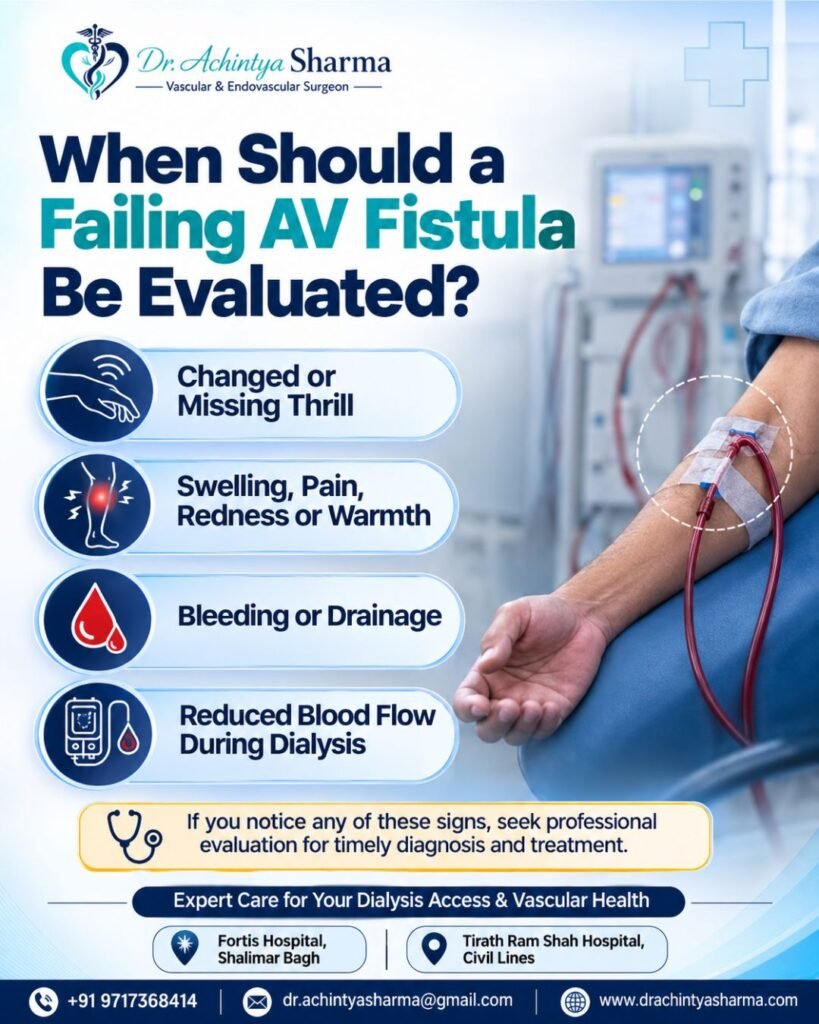
People receiving hemodialysis through an AV fistula should pay attention to changes in the access. Evaluation is particularly important when a new symptom occurs or when dialysis staff notice problems with blood flow or needle access.
Patients should seek professional evaluation if they notice a missing or changed thrill, unusual swelling, pain, redness, warmth, drainage, persistent bleeding, or difficulty achieving adequate blood flow during dialysis. These signs can have different causes, so diagnosis should be based on a clinical assessment rather than symptoms alone.
Common Warning Signs
- Loss or significant change in the normal AV fistula thrill
- A weaker or altered AV fistula bruit
- Reduced blood flow during dialysis
- Repeated difficulty with needle placement
- Swelling in or around the access arm
- Pain, redness, warmth, or drainage
- Unusual or prolonged bleeding after needle removal
- A noticeable change in how the fistula looks or feels
Top Signs and Symptoms of a Failing AV Fistula
1. Loss of the Fistula Thrill
One of the most important warning signs is the disappearance or significant change of the usual vibration over the fistula. This vibration, known as a thrill, is produced by blood moving through the access. If the normal thrill suddenly disappears or feels substantially different, the patient should contact their dialysis team promptly.
2. Weak or Changed Bruit
A bruit is a sound created by blood moving through the vascular access and is typically assessed by a healthcare professional using a stethoscope. A change in the expected sound can suggest altered blood flow and may require further evaluation.
Patients should not attempt to diagnose stenosis or thrombosis based on the bruit alone. Professional assessment is needed to determine whether an underlying access problem is present.
3. Reduced Dialysis Blood Flow
Difficulty maintaining adequate blood flow during hemodialysis can be a sign of an access problem. Reduced flow may occur when the access becomes narrowed or obstructed.
Problems with vascular access can interfere with effective dialysis and may require additional evaluation or treatment. NIDDK notes that vascular access can develop poor blood flow or blockage caused by a blood clot or scar tissue.
4. Swelling, Pain, Redness, or Warmth
Swelling, worsening pain, redness, warmth, or fluid discharge around the fistula may signal infection or another vascular-access complication. Fever or chills together with these symptoms should receive prompt medical attention. The National Kidney Foundation specifically advises patients to report redness, warmth, swelling, pain, drainage, bleeding, and changes in how the access feels or works.
5. Sudden Loss of Function
Sudden fistula dysfunction can occur when a clot, narrowing, or another vascular problem interferes with normal blood flow.Thrombosis and inadequate maturation are recognized causes of AV fistula failure, particularly in newly created accesses.
What Causes AV Fistula Failure?
Several conditions can contribute to AV fistula failure symptoms.
Stenosis
Stenosis means narrowing within the vascular access. Narrowing can restrict blood flow and may contribute to further access dysfunction or thrombosis.
Thrombosis
Thrombosis occurs when a blood clot obstructs the access and prevents normal blood flow. A completely blocked fistula may no longer provide adequate access for dialysis.
Infection
An AV fistula can develop an infection, which may cause redness, warmth, swelling, pain, drainage, fever, or chills. Prompt medical assessment is important when infection is suspected.
Inadequate Maturation
A newly created AV fistula may not develop sufficiently for reliable dialysis use. NIDDK research identifies inadequate maturation as an important factor associated with AV fistula failure.
Other factors can include problems with the blood vessels, repeated access-related trauma, or pressure affecting the access arm. The dialysis and vascular teams can determine the specific cause.
How Is a Failing AV Fistula Diagnosed?
Evaluation generally begins with a physical examination and a review of the fistula’s function during dialysis. Healthcare professionals may assess the thrill, bruit, access appearance, blood flow, needle-related problems, and dialysis performance.
Depending on the findings, additional vascular imaging or other investigations may be recommended to identify stenosis, thrombosis, or another structural problem.
The goal is not simply to determine whether the fistula is failing. Assessment also helps establish whether the access can potentially be repaired or salvaged.
Treatment Options for a Failing AV Fistula
Treatment depends on the cause, severity of the problem, and condition of the existing vascular access.
Possible approaches may include:
- Angioplasty or other endovascular treatment for clinically significant narrowing
- Thrombectomy or clot-directed treatment when thrombosis is responsible
- Surgical revision when the access requires an operative repair
- Treatment of infection, which may involve antibiotics and management of the affected access
- Creation of another vascular access if the existing fistula cannot be effectively maintained
The KDOQI vascular-access guidance includes recommendations and clinical resources covering significant access stenosis, thrombosis, infection, aneurysm, pseudoaneurysm, and other vascular-access complications.
How Does an AV Fistula Compare With Other Dialysis Access Options?
| Feature | AV Fistula | AV Graft | Catheter |
| Construction | Artery connected directly to vein | Synthetic tube connects an artery and vein | Tube placed in a large vein |
| Typical role | Often preferred when suitable | Alternative when a fistula is unsuitable | Often used when dialysis access is needed quickly |
| Infection risk | Generally lower than catheter | Higher than fistula | Higher than fistula or graft |
| Clotting risk | Generally lower than graft | Higher than fistula | Can develop access-related problems |
| Maintenance | Regular monitoring required | Regular monitoring required | Careful infection prevention required |
An AV fistula is often preferred when suitable because it generally provides durable access with lower infection and clotting risks than other access types.
When Is a Failing AV Fistula an Emergency?
Some AV fistula problems require immediate attention. Patients should contact their dialysis team, doctor, or seek urgent medical care according to the severity of the situation if they experience:
- A fistula that suddenly stops buzzing or vibrating normally
- Bleeding that does not stop
- Severe pain or rapidly increasing swelling
- Significant redness, warmth, or drainage
- Fever or chills with access-site symptoms
- A sudden and significant change in how the fistula works
The National Kidney Foundation specifically recommends prompt attention for absent or changed access vibration, persistent bleeding, and symptoms such as severe pain, swelling, redness, warmth, drainage, fever, or chills.
Best Practices for Protecting an AV Fistula
Regular access care can help patients recognize changes early:
- Check the normal thrill as instructed by your dialysis team.
- Report a sudden change or loss of the thrill promptly.
- Avoid blood-pressure measurements on the fistula arm.
- Avoid unnecessary blood draws from the access arm.
- Avoid tight clothing, jewelry, or pressure over the access.
- Follow the hygiene instructions provided by your dialysis team.
- Tell the dialysis team about repeated bleeding, swelling, pain, redness, or dialysis-flow problems.
AV Fistula Surgery in Delhi: When Specialist Evaluation May Be Needed
Patients searching for AV fistula surgery in Delhi may need specialist evaluation when symptoms suggest access dysfunction. The appropriate treatment depends on the condition of the existing fistula, the underlying cause, the patient’s vascular anatomy, and ongoing dialysis requirements.
A vascular specialist can work with the patient’s dialysis and nephrology teams to determine whether the access may be treated, repaired, or replaced. Treatment decisions should be individualized rather than based solely on symptoms.
FAQs
1. How often should I check my AV fistula?
Patients should follow the checking routine recommended by their dialysis team. Regularly checking the normal thrill can help identify a significant change in access function. If the vibration disappears or feels different from normal, patients should contact their dialysis team promptly.
2. Is a weak thrill always a sign of fistula failure?
Not necessarily. A weaker or changed thrill can have different causes, and it does not by itself confirm fistula failure. A healthcare professional should assess the access to determine whether narrowing, thrombosis, or another complication is present.
3. What are AV fistula blockage symptoms?
AV fistula blockage symptoms may include a sudden loss or major change in the normal thrill, reduced dialysis blood flow, or difficulty using the access. A blood clot can obstruct vascular access and interfere with dialysis.
4. Can infection cause AV fistula problems?
Yes. Infection may cause redness, warmth, swelling, pain, drainage, fever, or chills around the access. These symptoms should be reported promptly because vascular-access infections can require medical treatment.
5. What causes AV fistula thrombosis?
AV fistula thrombosis occurs when a blood clot blocks the access. Significant narrowing and other blood-flow problems can contribute to access dysfunction and thrombosis. Early fistula failure can also be associated with thrombosis or inadequate maturation.
6. Can a failed AV fistula be repaired?
Some failing fistulas can be treated or salvaged, depending on the underlying problem and the condition of the access. Treatment may include endovascular procedures, clot removal, or surgical revision. A vascular-access specialist can determine which approach is appropriate.
7. Can an AV fistula be replaced?
If an existing fistula cannot be effectively repaired or maintained, another vascular-access option may be considered. The decision depends on the patient’s blood vessels, dialysis needs, previous access history, and overall clinical situation.
8. Why is AV fistula care important for dialysis patients?
An AV fistula provides the vascular access needed for hemodialysis. Monitoring the access and reporting changes early can help healthcare professionals identify problems that could interfere with dialysis.
About the Medical Reviewer
Dr. Achintiya Sharma is the medical reviewer for this article. The content has been prepared for general educational purposes and should be considered alongside individualized advice from the patient’s dialysis, nephrology, and vascular-care team
Conclusion
Recognizing the signs of a failing AV fistula can help dialysis patients seek timely evaluation when their access changes. A missing or altered thrill, changed bruit, reduced blood flow, swelling, pain, infection symptoms, or sudden loss of function should not be ignored. Patients in Delhi experiencing AV fistula failure symptoms should discuss these changes promptly with their dialysis team or an appropriate vascular specialist. Those researching AV fistula surgery in Delhi should review their options carefully and seek individualized medical advice before choosing treatment.
Medical Disclaimer
This article is intended for general educational purposes and does not replace professional medical diagnosis, treatment, or advice. Patients experiencing changes in an AV fistula should contact their dialysis or healthcare team promptly. In an emergency, seek appropriate urgent medical care.
References
- National Kidney Foundation — Hemodialysis Access.
- National Kidney Foundation — KDOQI Vascular Access Guidelines.
- National Institute of Diabetes and Digestive and Kidney Diseases (NIDDK) — Hemodialysis.
- NIDDK — Hemodialysis Fistula Maturation Consortium.
- NIDDK — FISTULA Study: Early AV Fistula Thrombosis.